An Airline in Crisis Mode: How Qatar Airways Survived 2026 and Lost Its Members Anyway
Markus Neubauer · 2026-08-19
Qatar Airways evacuated 22 of its newest jets to a Spanish desert in six days - and needed five months, five cases and an ignored CEO letter to answer one member's yes-or-no question. The full 2026 arc, ending with a farewell the airline processed in a day.

An Airline in Crisis Mode:
How Qatar Airways Survived 2026 and Lost Me Anyway
“They evacuated their newest jets to a Spanish desert in six days. My one question took eight weeks, five cases and a letter to the CEO — and the only request they ever processed quickly was my request to leave.”
In 2026, Qatar Airways faced two crises at once, and the record of this membership account says it won exactly one of them. The first crisis was operational: closed airspace, a grounded network, a fleet in harm’s way. That one it handled with genuine competence — flights suspended the moment safety demanded it, aircraft ferried across a continent, a network rebuilt through safe corridors within months. The second crisis was quieter and, for the airline, far more expensive: the tens of thousands of small administrative aftershocks the first crisis set off in its members’ accounts — the claims, the loyalty questions, the complaints. That one it lost, in my case one unanswered message at a time, over five documented months, ending this week with a farewell the airline processed faster than any request I ever made of it. This is the story of both crises, told from inside one Privilege Club account — with the receipts.
The short version
When the missiles flew, Qatar Airways moved decisively: operations suspended, more than twenty of its newest jets parked in the Spanish desert, corridors rebuilt, 150-plus destinations restored by mid-June. When its own cancellations knocked a hole in my loyalty-tier qualification, the same airline needed eight weeks and five cases to answer one yes-or-no question, misquoted its own arithmetic in writing, brushed aside a letter to its Group Chief Executive, froze 90,000 of my Avios after a failed upgrade, and phoned me at 08:47 on a Sunday to say nothing. On 18 August I asked it to close my case and let me go. That request — alone among all of them — was handled within a day, with a written apology for ‘the lack of follow-up’ attached to the goodbye.
The crisis Qatar Airways handled well
Credit first, because it is real and because everything that follows lands harder for it. When regional conflict closed Qatari airspace in early March, Qatar Airways did the only responsible thing an airline can do: it stopped flying. At the peak, the large majority of its schedule was grounded. Passengers were offered refunds or free rebooking across a months-long travel window. And rather than leave billions of dollars of aircraft sitting under a contested sky, the airline moved them — fast.
By late March, flight-tracking data counted 22 Qatar Airways jets parked at Teruel Airport in Aragón, Europe’s largest aircraft storage site, most of them arriving in a single six-day surge — and not the old ones: A380s, A350s, Boeing 787s, the flagships, ferried in from Doha and from stations across three continents. The airline called it a temporary positioning of aircraft outside Qatar; analysts read it as key assets being moved out of harm’s way. Whether the deeper calculus was prudence, preservation, or the quieter arithmetic of war-risk cover, the airline does not say and I will not pretend to know. As crisis management for machines, it was exemplary: decisive, fast, comprehensive. Hold that thought.
By 16 June the airline was publishing an expanded schedule of more than 150 destinations, routed through dedicated corridors. As an operational recovery, genuinely impressive. If this article were only about aeroplanes, it would be a positive review.
What stayed flying — and what that felt like on board
But an airline in crisis mode makes trade-offs, and passengers live inside them. With the newest widebodies sunning themselves in Aragón, the schedule that survived fell disproportionately to the older end of the fleet: the veteran 777s that have carried this airline for the better part of two decades, and, on my home Larnaca run, the fifteen-year-old A320s this publication has already reviewed, museum-piece entertainment and all.
My partner flew to Japan in the QSuite in the middle of all this. On the outbound, boarding on one leg was cancelled outright: an engine failure on the aircraft, caught before departure. Let me be fair, because fairness is the house style: an engine problem found at the gate is the system working, and I will take a cancelled boarding over a confident dispatch every day of the week. But on the return, he watched from his suite as the left engine stuttered and breathed out a cloud of white smoke. Two engine events, one round trip, one passenger. I cannot tell you which aircraft would have operated those sectors had the fleet been whole; nobody outside Doha can. I can tell you what did operate them — and that when an airline’s newest jets are parked in a desert, questions about the age and strain of what remains flying stop being rhetorical.
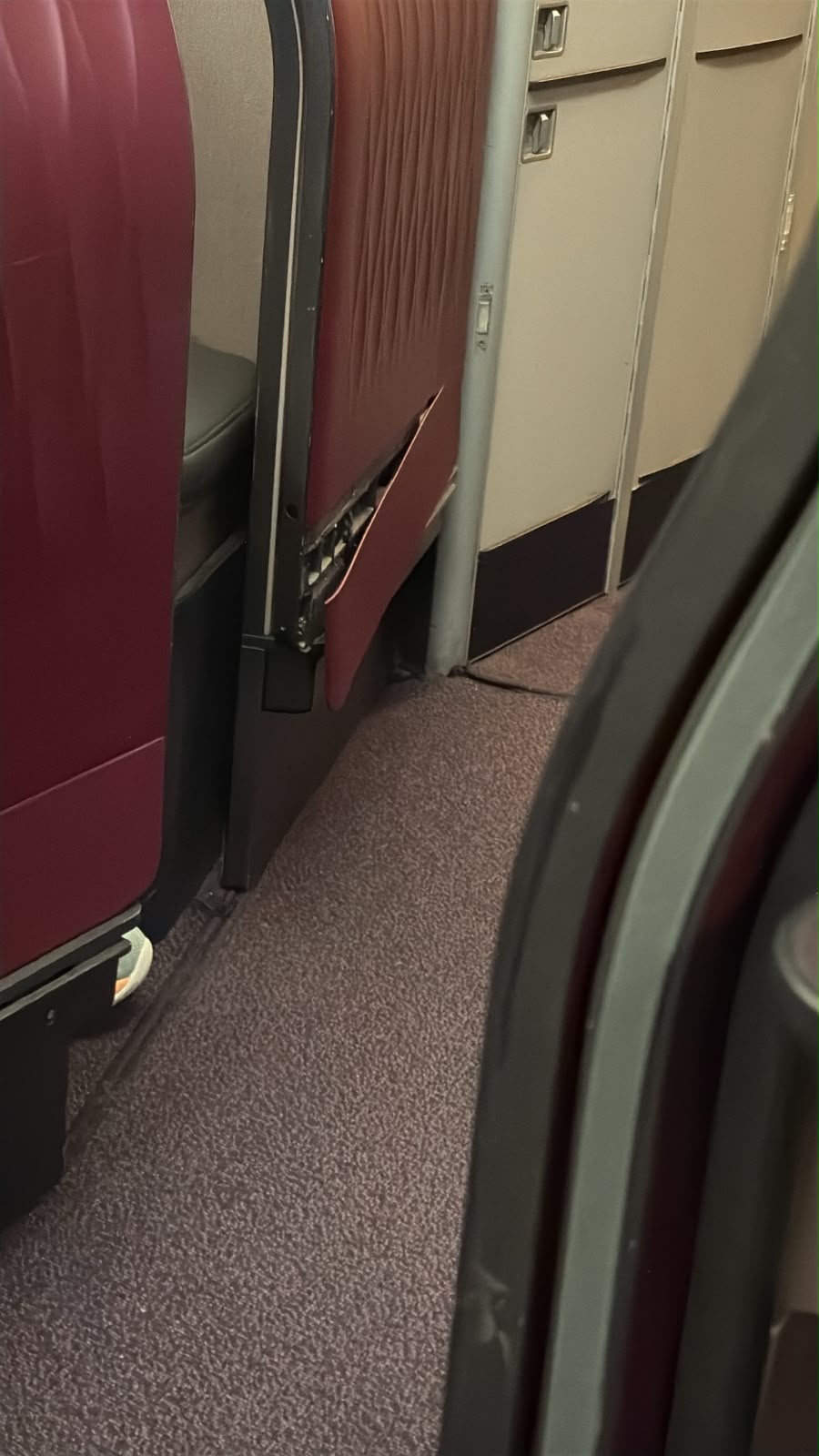
The QSuite my partner flew to Japan — still one of the finest business seats in the sky, flying through the airline’s strangest year.
✈️ Planning around the disruption?
Schedules out of the Gulf are still shifting as the network rebuilds. Compare live fares and routings before you commit your own points run or repositioning.
Search Flights on AviasalesThe second crisis: the members
Now the other half of the ledger — the one the airline did not evacuate to safety. Among the flights Qatar Airways cancelled were two of mine, booked and paid for on its own aircraft, and needed, as it happened, to satisfy the airline’s own minimum-sector requirement for loyalty-tier qualification. What followed is a story I have told at full length — five cases, an ignored CEO letter and 90,000 frozen Avios: the complete documented account — so here I will give only the shape of it, because the shape is the point.
One yes-or-no question — would the sectors Qatar Airways itself cancelled still count toward its own sector requirement? — took eight weeks and five separate service cases to get answered, and the answer, when a single honest agent finally gave it, was no. Along the way the airline told me in formal correspondence that I was 40 points short of a threshold its own dashboard showed me exceeding by 51. A civil, detailed letter to the Group Chief Executive was met with the machinery — concerns noted, teams informed — and nothing else. A failed Avios upgrade deducted roughly 90,000 miles that were returned only after I chased them. An onboard survey vanished into forms that, by the airline’s own admission, acknowledge nothing by design. And the airline’s one proactive gesture in five months was a sixty-second phone call at 08:47 on a Sunday morning — placed while my partner was airborne on its own aircraft, and I, his listed emergency contact, was asleep — that named no subject and conveyed no information at all.
The airline’s one proactive gesture in five months: 08:47 on a Sunday, one minute, no content.
Nor was mine an isolated file. A friend — different continent, unrelated booking — had his return from Cape Town cancelled in the same disruption, accepted a rebooking offer in writing the same day it was made, and then watched it never be processed; was told, falsely, that he had never replied; and finally got home roughly twenty days late, some €1,300 and a slice of his annual leave poorer. Same airline, same months, same failure: courteous agents wired into a system that logs everything and resolves nothing. One case is misfortune. Two unrelated ones, in identical shape, is a pattern — and I suspect the true number has several more digits.
📱 Stranded somewhere unplanned?
If 2026 taught travellers one thing, it is that reroutes happen and hold music is expensive. A global eSIM keeps you online in whatever country your rebooking lands you in.
Get Your Airalo eSIMHow it ends: five months to be ignored, one day to be let go
On 15 July, after all of that, the Privilege Club team called me about my open complaints. It was the last I heard from anyone. Five more weeks of silence followed — no letter, no email, no resolution — and at some point in those weeks I stopped being angry and simply finished the arithmetic myself. On 18 August I wrote a short, civil message through the airline’s own complaint form: close the case. I told them I was moving my Oneworld loyalty to Finnair Plus and my future travel and spending to East Asian carriers whose service on the ground matches their service in the air. I told them it was not written in anger — the onboard product remains excellent, and every individual agent I dealt with was courteous. And I told them the conclusion the past months had made unavoidable: a programme that cannot answer its members has, in the end, answered them.
The reply came within a day.
Read that again, because it is the whole story in one sentence. The question that took eight weeks. The letter to the chief executive that took forever, because forever is how long nothing takes. The escalation that promised 72 hours and delivered a phone call on day sixteen. And then a member says let me leave — and the machine, suddenly fluent, answers by the next day. The reply was polite. It acknowledged my request to close the complaint. It offered, in the airline’s own words, sincere apologies for the lack of follow-up
— the first written admission, five months in, that the follow-up had been lacking — and it regretted my decision to leave the programme, with appreciation for my past loyalty and candid feedback. And that was all. No question. No callback. No attempt of any kind to keep a member who had spent five months and five cases trying, in effect, to stay. The most efficient process at Qatar Airways, on the evidence of this file, is the one that shows you out.
Crisis mode is a setting for operations, not for relationships
Here is the thing I keep returning to. Every operational decision Qatar Airways made in 2026 was defensible, and most were right. Ground the fleet: right. Move the jets: right. Rebuild slowly and safely: right. If the airline had communicated one tenth as well as it operated, this would be a case study in crisis management and I would still be a member. Instead, the same organisation that could evacuate twenty-two widebodies across a continent in six days could not move one yes-or-no answer from its loyalty department to my inbox in eight weeks. That is not a resources problem. Doha does not lack resources. It is a priorities problem, made in an emergency and never unmade: somewhere in March, the customer side of this airline went into crisis mode too — and unlike the aircraft, it never came back.
It is exactly this gap that led Avios Intelligence to add a sixth dimension to our Oneworld carrier ratings, scoring not the seat but the airline you meet when something goes wrong. On the seat, Qatar Airways still earns an 8.5 from us, and deserves it; its lounges score a 9.0, the highest mark we award anyone in the alliance. On the other thing — the desk, the phone, the chat, the loyalty operation — it scores 4.5, and because that dimension carries the heaviest weight in our formula, the arithmetic does the rest.
So let me state the consequence plainly, because a rating that stays silent about its own reasons is worth nothing: on the strength of this experience, Qatar Airways no longer holds the top position in our Oneworld carrier ranking. It has not slipped because of its aircraft, its cabin crew or its lounges — all of which remain among the finest in the alliance, and one of which is still the best outright. It has slipped because of what happens when a booking breaks, which is the dimension this year tested and the dimension it failed. The two carriers now above it at the top of that table are Japan Airlines and Cathay Pacific, and it is no coincidence that they are precisely where my flying now goes. The position is neither a punishment nor a permanent verdict: we will revisit it the moment there is evidence that things have changed — a published service standard the airline actually meets, or a run of documented cases resolved inside the time it promises. Until then, the ranking says what the record says.
The Verdict: They Protected the Jets. Nobody Protected the Members.
An airline, in the end, is not its aircraft. The aircraft are the easy part — 2026 proved Qatar Airways can protect those brilliantly, at six days’ notice, across a continent. An airline is the promise that when your plan breaks, someone answers. That promise is what five months of this file tested, and what five months of this file broke: a question no one would answer, arithmetic no one would check, a letter no one would read, and a farewell processed with the speed and polish that every earlier request deserved and never received.
The QSuite remains one of the finest business seats in the sky. Al Mourjan remains the finest lounge in the alliance, and our ratings still say so. I will keep saying so in every ranking we publish, because it is true. But I will be saying it, from now on, as a passenger of other airlines — because Qatar Airways spent 2026 proving that it could move heaven, earth and twenty-two widebodies for its machines, and could not move one answer for a member. They flew their newest jets to safety in the Spanish desert. The members, they left under the contested sky.
Qatar Airways in 2026: Frequently Asked Questions
How did Qatar Airways handle the 2026 Middle East airspace crisis?+
Operationally, with real competence: when Qatari airspace closed in early March, the airline suspended flying immediately, offered refunds and free rebooking across a long travel window, ferried more than twenty of its newest aircraft to storage at Teruel in Spain, and rebuilt a network of 150-plus destinations through dedicated corridors by mid-June. The customer side of the crisis — claims, loyalty questions, complaint handling — is a different story, and it is the one this account documents.
Why did Qatar Airways cancel so many flights in 2026?+
Regional conflict closed Qatari airspace in early March 2026, and Qatar Airways suspended its Doha operation until safe corridors could be established — at the peak, the large majority of its schedule was grounded. The cancellations were a safety decision, and in my view unambiguously the correct one. The failures documented here all came afterwards, in how the airline handled the people those cancellations affected.
Does Qatar Airways compensate Privilege Club members when it cancels flights?+
Partially, and only with persistence. In my case the Avios and Qpoints from replacement flights were eventually credited, but it took multiple claims over several weeks. The cancelled sectors themselves — flights marketed and operated by Qatar Airways, cancelled by Qatar Airways — were not counted toward the airline’s own minimum-sector requirement for tier qualification, and no waiver was offered.
How do I escalate a complaint with Qatar Airways?+
The official channels are the web feedback form, live chat, the WhatsApp service, and the tell-us customer-care email; the airline quotes up to 10 working days for a response. Expect escalations ‘to the relevant team’ rather than answers, and document everything — dates, case numbers, transcripts. In my experience even a formal letter to the Group Chief Executive produced no substantive reply, so build your paper trail from day one.
What is the best alternative to Qatar Airways Privilege Club?+
It depends on where you fly from. Based in Europe, I moved my Oneworld loyalty to Finnair Plus and my long-haul flying toward Japan Airlines and Cathay Pacific — the two carriers at the top of our own ranking for how members are treated when something goes wrong. The Qatar Airways onboard product remains outstanding; the question is what stands behind it when a booking breaks.